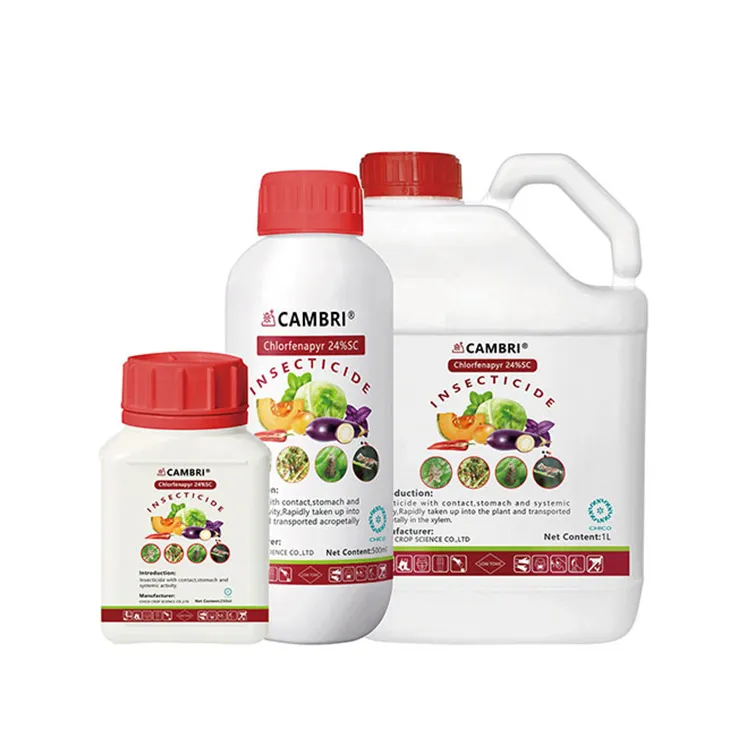
Specification
| Active ingredient | Chlorfenapyr 24% |
|---|---|
| Formulation | SC (suspension concentrate) |
| Line | Insecticides |
Standard formulation data. Registered content and label uses for a destination country follow its registration certificate.
How it works
Chlorfenapyr is a precursor of insecticide, which itself has no toxic killing effect on insects. But after insects eat or touch chlorfenapyr, it is converted into a specific insecticidally active compound inside their bodies under the action of multifunctional oxidase. The targets are mitochondria in somatic cells of the insect. The synthesis and biological functions of the cells are stopped due to lack of energy. After spraying the drug, pest activity weakens, spots appear color changes, and eventually stops activity, coma, paralysis, leading to death.
Chlorfenapyr is a pyrrole insecticides and acaricide with a novel structure. It has excellent control effect on drilling, piercing-sucking and chewing pests and mites. More effective than cypermethrin and cyfluthrin. Stronger than dicofol and cyhexatin.
Broad insecticidal spectrum; combined with gastric toxicity and contact killing effect; effect duration lasts for 10 days.
Low toxicity and high efficiency. No cross resistance with other pesticides.
Crops and targets listed
- Crops
- Cruciferous vegetables such as cabbage, kale, Chinese cabbage, and pakchoi, beans, cowpea, leek, cucumber, chieh-qua, eggplant, tea, apple, pear, citrus, etc.; Cabbage; Cucumber; Eggplant; Green vegetable; Scallion
- Targets
- Various pests such as diamondback moth, the small white, beet armyworm, tropical armyworm, cabbage webworm, mustard aphid, leafminer, and thrips.; Mustard aphid; Leafminer; Tropical armyworm; Diamondback moth; Beet armyworm
Use and dosage as published
- | Crops | Targets | Dosage | Application method
- 375-495 ml/ha
- | Spray
- | Cabbage |
- Diamondback mot
- | Cucumber |
- 600-750 ml/ha
- | Eggplant |
- Thrips
- 300-450 ml/ha
- Red spider
- Spray
- | Tea |
- Tea green leafhopper
- 375-450 ml/ha
- | Pear |
- Psyllids
- Diluted to 1250-2500 times
- | Apple |
- Topical armyworm
- Diluted to 4000-6000 times
- 1. Cucumber: Apply at the peak or early larval stage of egg hatching, applying once every 7-10 days, and use it twice consecutively, but no more than 2 uses per growing season.
- 2. Eggplant: Use the drug before the nymph stage, thrips nymph stage or early larvae stage, and before the peak of the pest occurs. The safety interval is 7 days, and no more than 2 uses per growing season.
- 3. Tea tree: Apply the drug during the nymph's flourishing period, once. The safety interval is 7 days, and no more than 1 use per growing season.
- 4. Apple tree: Apply the pesticide in the peak period of egg hatching, and apply it once every 7-10 days, and use it twice consecutively. The safety interval is 14 days, and it is used no more than 2 times in each growing season.
- 5. Pear tree: Foliar spray 1-2 times. The drug was started at the early stage of the young larvae (1-2 instars), and the first control was carried out when the shoot shoots were 5 cm long. If there are overlapping generations of nymphs, the drug should be used twice consecutively, with an interval of 7-10 days, and the safety interval is 14 days. It is used no more than 2 times in each growing season.
Follow the registered label in your country. Trial on a small area first.
Cautions
Handling and mixing notes
Each crop can only be used up to 2 times to avoid drug resistance; the safety interval on cruciferous vegetables is tentatively set at 14 days.
Sensitive to cruciferous vegetables or melon crops such as watermelon, zucchini, bitter gourd, melon, muskmelon, winter melon, pumpkin, hanging melon, loofah, etc. It is not recommended for use during the tender leaf stage.
This agriculture insecticide is toxic to fish, and cannot be directly sprayed to the water and water source; because of its toxicity to aquatic organisms, there are potential risks in the application of rice fields.
Get a quotation with the formulation sheet
Tell us the active ingredient, content, formulation, quantity and destination country. Samples are available within 2 to 5 days.
- Six lines, one supplier: insecticides, fungicides, herbicides, PGRs, biostimulants, fertilizers
- Formulation customization and small pack options
- Registration support documents on request